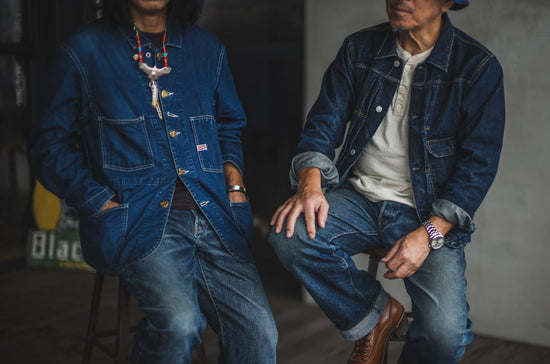
Two approaches, two different pairs of jeans.

+ When to Wash: Contrast or Comfort

For maximum contrast
Wear the jeans as long as you comfortably can before the first wash, usually three to six months of regular wear. In that time the creases set at the hips, lap and knees, and the indigo wears away along them while the rest of the cloth stays dark. When the jeans are finally washed, the worn lines are already pale. The fades come out sharp-edged and high in contrast. After the first wash, keep washes infrequent. Spot-clean marks, air the jeans between wears and wash only when they need it.

For comfort and cleanliness
Wash whenever the jeans are dirty or start to smell, which with daily wear might be every few weeks. Each wash takes a little indigo evenly from the whole garment, so the base colour lightens at the same time as the creases fade. The fades still come, but they are broader, softer and lower in contrast. Over time this gives the even, lived-in blue of an old pair of work jeans.

Our view
Wash your jeans when they need it. Dirt and grit are abrasive, and sweat and body oils weaken cotton over time. A pair that goes many months without a wash fades sharply, but it is also more likely to wear through at the crotch and thighs sooner. If contrast matters to you, hold off on the first wash and wash sparingly after that. If it does not, wash them as you would any good garment, with a little care. Either way, the jeans end up shaped by how you wore them.

Machine, soak, and the first wash of raw denim.

+ How to Wash Your Jeans

Inside out, fly done up
Washing jeans has been made more complicated than it needs to be. A washing machine is fine, and is close to how denim is washed in Japanese wash houses, at a smaller scale. Turn the jeans inside out and do up the fly first. This protects the face of the cloth from the drum and stops the indigo streaking or marbling.

Cold water, gentle cycle
Wash at 30°C or below on a gentle or delicate cycle with a low spin. Warm water shrinks cotton and lifts more indigo, so keep it for the first wash of a raw pair. Wash the jeans alone or with other dark garments for the first several washes. The indigo will bleed into the water.

Mild detergent, nothing else
Use a small amount of mild liquid detergent. Avoid bleach and detergents with optical brighteners, which can leave a chalky or uneven cast on indigo. Fabric softener is not needed.

Hand washing or soaking
To keep abrasion to a minimum, soak the jeans instead. Turn them inside out, submerge them in a bath or large tub of cold to lukewarm water with a little mild detergent, press them under and move them gently, then leave them for 30 to 45 minutes. Drain, rinse in clean water and press out the water without wringing. A soak takes less indigo than a machine wash and helps hold contrast.

The first wash of raw denim
Most of the jeans we stock arrive once-washed, so most of the shrinkage has already been taken out and the size you try on is close to the size you keep. Raw, unsanforized denim, sold as shrink-to-fit, has not been shrunk at all. A warm first wash or soak, around 40°C, sets the shrinkage and softens the cloth. A pair of Fullcount S0105 we washed at 40°C lost 3cm across the waist, 2cm across the hem and 5cm in length. Hem raw jeans after the first wash, never before. Our full walkthrough is in Unsanforized Jeans: A Guide to Buying and Washing Them.

A rough guide for 13 to 15oz denim worn most days.

+ How Long Fades Take

The first four to eight weeks
The indigo softens and the creases at the hips, lap and behind the knees begin to set. There is little visible fading yet, but the pattern is being decided.

Three to six months
Whiskers across the lap and honeycombs behind the knees become clearly visible. The pocket edges, belt loops and hem start to show wear, and a wallet or phone leaves its outline in the back pocket.

Nine to twelve months
The fades are defined, and the difference between worn and unworn areas is obvious from a distance. On high-contrast fabrics this is where a pair starts to look properly worn in.

Beyond a year
The base colour keeps lightening, the fades sharpen or soften depending on how often the jeans are washed, and the cloth becomes noticeably softer.

Weight and wear
Heavier denim takes longer. An 18oz or 21oz fabric is stiffer, resists creasing and can take twice as long to reach the same point, while lighter cloth around 12oz softens and fades faster. Wear counts for more than time. Six months at a desk is not six months on a bike or on your feet all day.

Drag to compare a high-contrast fade with a vintage fade.

High contrast
Vintage

+ Continue Browsing

+ Frequently Asked Questions

Wash them when they are dirty or smell. If you want high-contrast fades, wear them three to six months before the first wash and wash sparingly after that. If you prefer a softer, even fade, washing every few weeks with daily wear is fine.

Most Japanese jeans are sold once-washed and can be worn straight away. Raw, unsanforized jeans should be soaked or washed before you hem them, as the first wash can take several centimetres off the length.

Yes. Turn them inside out, do up the fly, wash cold on a gentle cycle with a mild detergent, and hang them to dry. Never use a dryer.

Once-washed and sanforized jeans shrink very little in a cold wash. Raw, unsanforized jeans shrink noticeably on the first warm wash, typically a few centimetres at the waist and around five centimetres in length.

With regular wear, whiskers and honeycombs usually appear within three to six months, with defined contrast after nine to twelve months. Heavier fabrics and lighter wear take longer.

High-contrast fades show sharp, pale lines against a dark base and come from deep ring-dyed indigo, heavier fabric and infrequent washing. Vintage or low-contrast fades are softer and more even, from lighter dyeing, softer fabric or more regular washing.

No. Cold does not reliably kill the bacteria that cause odour. Airing jeans between wears helps, and when they smell, wash them.

Loose indigo sits on the surface of new denim and transfers with friction, especially when damp. It reduces with each wash. Until then, take care with light-coloured shoes, bags and upholstery.

As soon as the fabric at the crotch or thighs starts to thin. Reinforcing worn denim before it tears gives a smaller, neater repair and extends the life of the jeans considerably.

Didn't find your answer?

Get in touch and we will help with sizing, fit, fabric, or care advice.